Atlanta Catholic Parishes Reimagine Hospitality Through Zero Waste and Integral Ecology
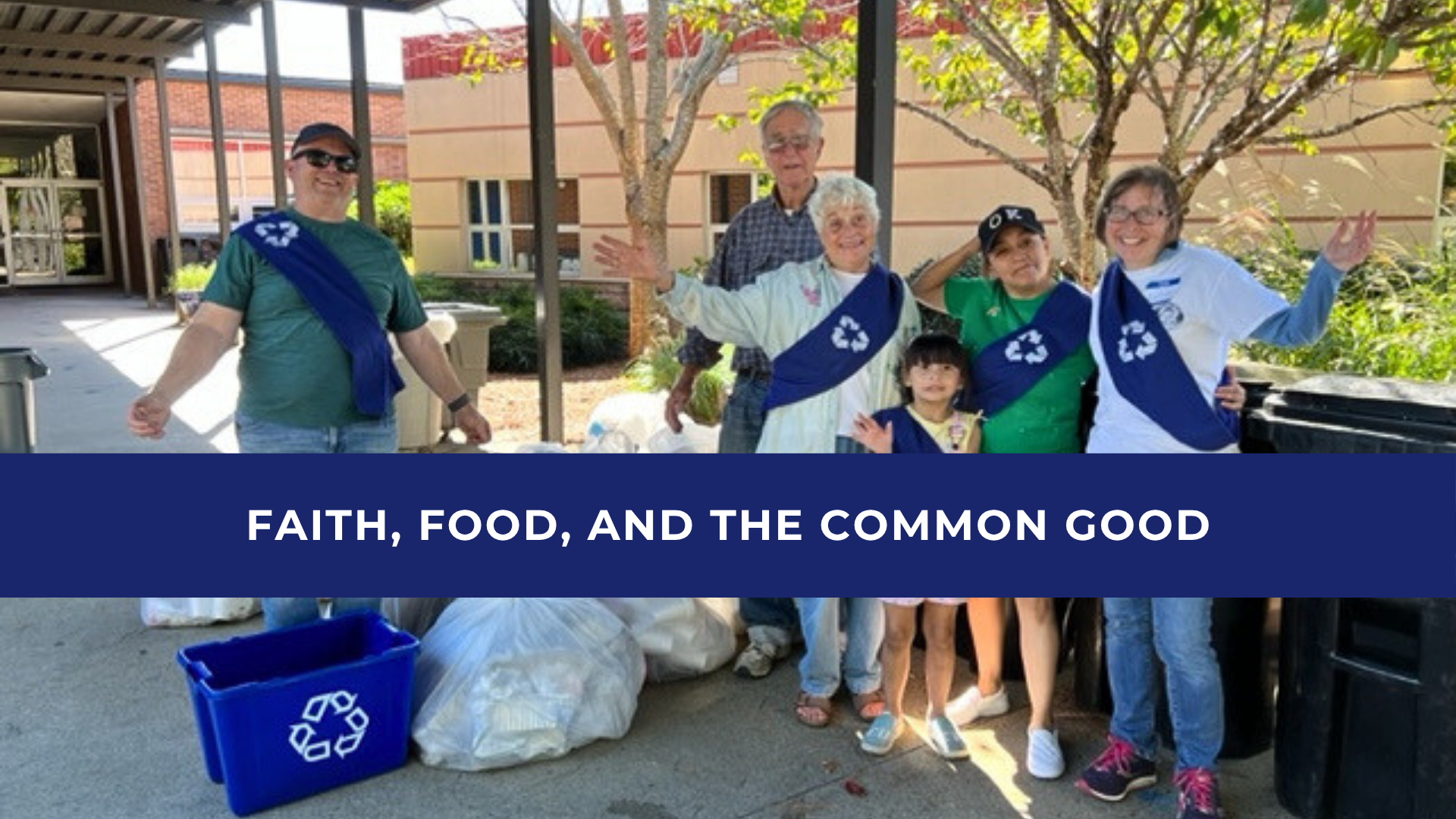
Written by Jay Bassett, a Catholic Green Team member and GIPL advisor. Photo by Jay Bassett.
Some of the most meaningful moments in faith communities happen around shared meals, festivals, fish fries, picnics, and celebrations. These gatherings nourish relationships and strengthen community. They can also generate significant amounts of waste.
Across the Archdiocese of Atlanta, two Catholic parishes, Immaculate Heart of Mary (IHM) in North Decatur and Our Lady of the Assumption (OLA) in Brookhaven, are demonstrating how hospitality and stewardship can work hand in hand through a growing commitment to zero-waste events, composting, and responsible resource management.
While rooted in Catholic tradition, their work reflects a value shared across many faiths: caring for our communities and caring for the Earth are deeply connected.
Pope Francis called this vision integral ecology in Laudato Si’—the understanding that environmental, social, economic, and spiritual wellbeing are interconnected. Pope Leo XIV has continued to build on this foundation, emphasizing human dignity, gratitude, beauty, and the common good. Together, these ideas invite us to see waste not simply as a technical problem, but as a question of stewardship, relationships, and community responsibility.
From Recycling to Integral Ecology
Long before Laudato Si’ was published in 2015, members of Immaculate Heart of Mary were already exploring what faithful stewardship could look like in parish life.
Beginning around 2006, parish volunteers formed an environmental ministry focused on practical actions that could reduce waste while preserving the parish’s strong tradition of hospitality. The annual parish picnic became an early testing ground. Volunteers organized recycling efforts, collected materials that would otherwise be discarded, and helped parishioners think differently about what they threw away.
The ministry worked closely with parish leadership and the Men’s Club to eliminate Styrofoam and many single-use plastics at parish events, particularly the popular Lenten Fish Fries. Together, they invested in reusable plates, glasses, cups, and utensils while introducing compostable takeout containers where reusable options were not practical. Plastic water bottles were largely replaced with beverage dispensers and refill stations.
Following renovation of the parish hall, the ministry expanded beyond recycling toward a broader zero-waste approach. Reusable dinnerware is now readily available for parish events, with compostable alternatives used when necessary. Sustainability became embedded in the daily life of the parish rather than remaining a stand-alone project.
The results have been remarkable.
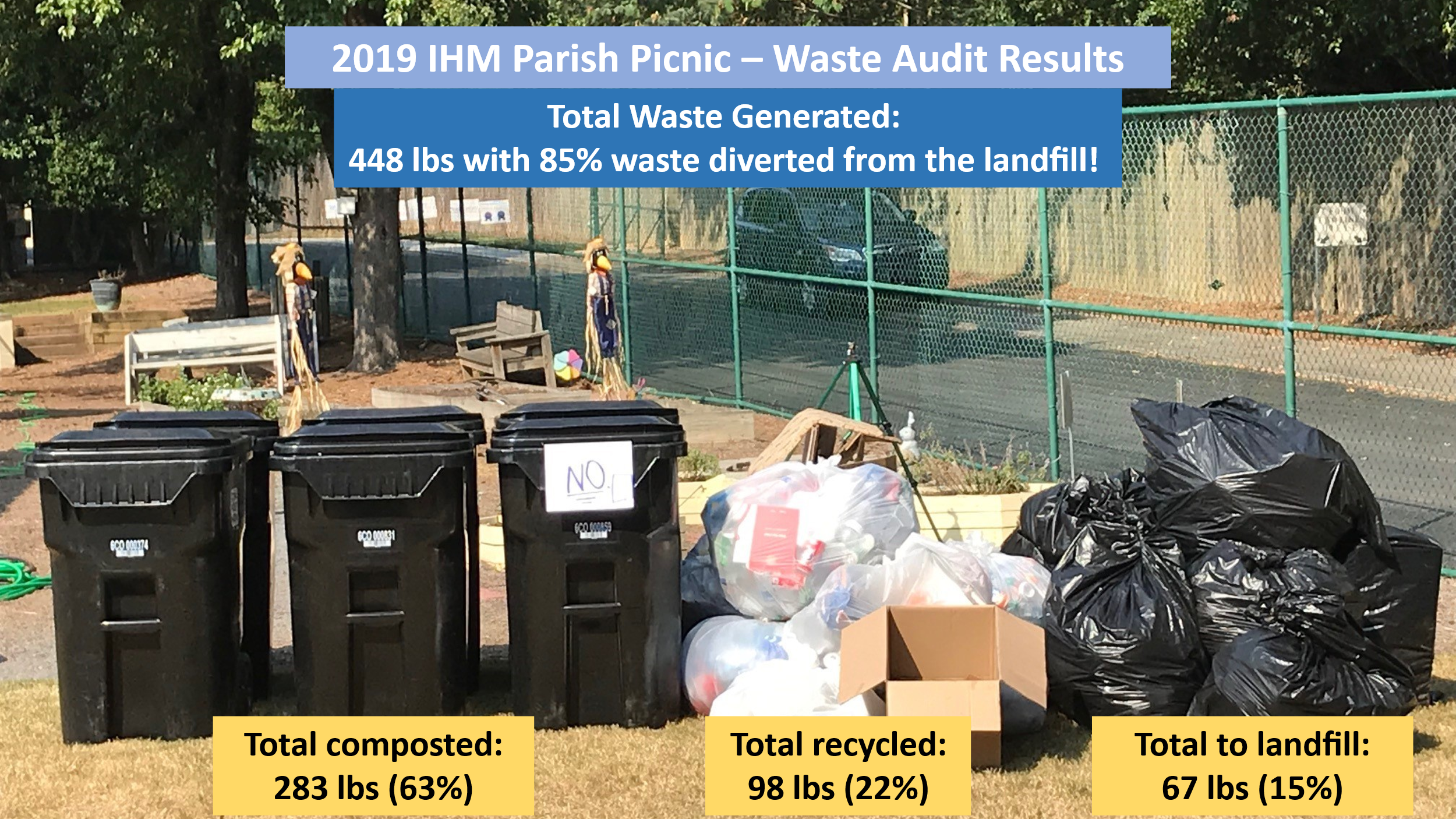
In 2019, the IHM Parish Picnic generated 448 pounds of waste while achieving an 85% landfill diversion rate through composting and recycling efforts. By 2022, total waste had fallen to 298 pounds while diversion increased to 89%. Composting alone accounted for more than three-quarters of all materials collected. In 2024, the parish served approximately 1,000 meals across three events while maintaining an 86% diversion rate and generating only 282 pounds of total waste.
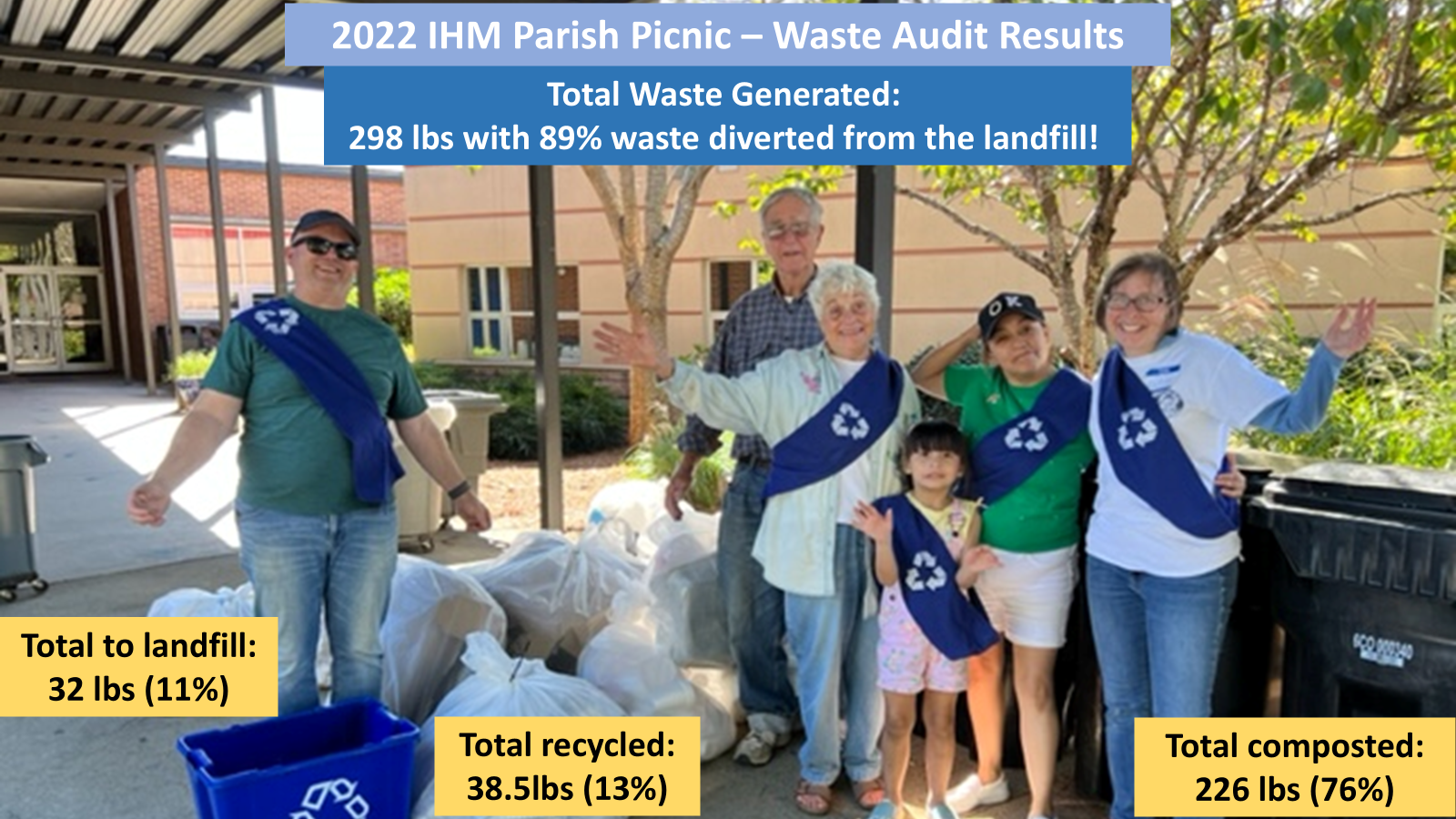
More important than the numbers, however, is the culture that has emerged. Volunteers staff composting stations, children learn how to sort materials, and parishioners actively participate in stewardship practices. What began as a recycling effort has evolved into a living example of integral ecology, where care for people, resources, community, and creation are viewed as part of a shared mission.
(Images courtesy of Jay Bassett.)
Hospitality Without Waste
At Our Lady of the Assumption, a similar transformation is underway.
Over the past 18 months, OLA’s Care for Creation Ministry has partnered with other parish ministries to host several large-scale events built around zero-waste principles.
A Marist Celebration welcoming approximately 700 attendees diverted nearly all event materials through composting and recycling. An Iftar Dinner hosted by the parish’s Indonesian community generated less than one pound of landfill waste. Most recently, a Cinco de Mayo celebration serving more than 300 people demonstrated how cultural traditions, hospitality, and environmental stewardship can strengthen one another.
These efforts are not simply operational improvements. They create visible examples of values in action that participants can carry into their homes, workplaces, schools, and neighborhoods.
Beyond Recycling
The movement toward lower-waste events is gaining momentum nationally. A 2023 Environmental Defense Fund article, “Life Is a (Low-Waste) Picnic,” highlighted how composting, reusable service ware, and volunteer engagement can dramatically reduce waste while strengthening community participation.
The experiences of IHM and OLA suggest something even larger. Their efforts show that environmental stewardship is not primarily about recycling bins or waste audits. It is about relationships.
Integral ecology reminds us that healthy communities depend upon healthy ecosystems, healthy soils, clean air and water, and responsible systems of production and consumption. It also recognizes that many environmental challenges stem from the same forces that weaken communities: disposability, isolation, and short-term thinking.
When faith communities reduce waste, eliminate unnecessary plastics, compost food scraps, and invest in reusable systems, they are doing more than managing materials. They are practicing gratitude, strengthening community, and caring for future generations.
In a culture often defined by convenience and disposability, these Atlanta parishes offer a different vision of one rooted in stewardship, hospitality, and the common good. Their experience reminds us that caring for creation often begins with simple acts close to home: how we gather, how we share meals, and how we honor the gifts entrusted to us.
In doing so, they demonstrate that communities of faith can become places not only of worship and fellowship, but also of ecological renewal, resilience, and hope.