Sowing Seeds for a New Creation
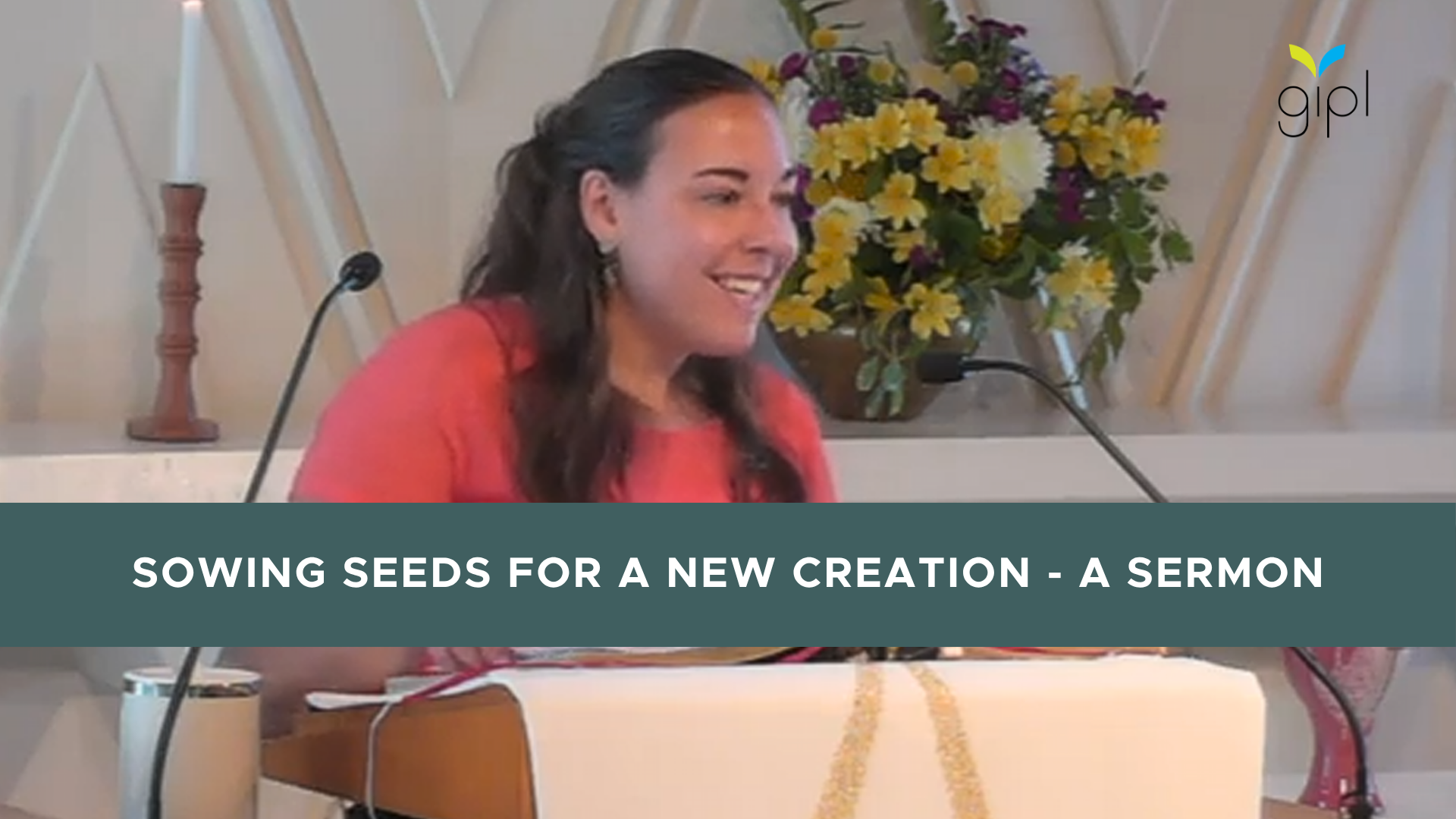
Written and delivered by Hannah Shultz, M.Div. at North Decatur Presbyterian Church in Decatur, Georgia, on April 26, 2026.
Scripture Reading – Mark 4:26-32 (NRSVue)
26 He also said, “The kingdom of God is as if someone would scatter seed on the ground 27 and would sleep and rise night and day, and the seed would sprout and grow, he does not know how. 28 The earth produces of itself first the stalk, then the head, then the full grain in the head. 29 But when the grain is ripe, at once he goes in with his sickle because the harvest has come.”
30 He also said, “With what can we compare the kingdom of God, or what parable will we use for it? 31 It is like a mustard seed, which, when sown upon the ground, is the smallest of all the seeds on earth, 32 yet when it is sown it grows up and becomes the greatest of all shrubs and puts forth large branches, so that the birds of the air can make nests in its shade.”
The year after I graduated from college, I served as a full-time volunteer with Brethren Volunteer Service, living in an intentional community house just outside of Chicago. One of the best parts of the house was the flourishing garden in our backyard.
When I moved into the house in mid-August the garden was overflowing with a late summer harvest. We spent the fall eating okra, peppers, tomatoes, and squash. This garden brought color to our dinner table and supplemented our otherwise simple meals. Since we lived outside of Chicago, winter brought multiple feet of snow and ice to our garden for a few months. Then, when the world began to thaw in the spring, I got to learn how to re-cultivate a garden for a new season.
One of my housemates, an avid gardener, taught me how to grow vegetables from seed. We planted tiny seeds into small pots and waited. We watered them. We turned them towards the sun. We checked on them every evening, anxious for signs of life.
And slowly - quietly- green shoots pushed through the soil. Not all of them made it, but enough did. We transferred these beginner sprouts to bigger pots and eventually took them outside to the garden where we planted them.
There was joy in that garden. Joy in watching something small bring abundance to our table. Joy in knowing that life - quietly, persistently - was unfolding around us.
We were like the farmer in this parable, scattering seed, tending the sprouts, and watching and waiting while the life sown in our little pots grew into a bountiful harvest.
In Mark, this is the second of three “seed” parables that are used to help the disciples weave together an understanding of God’s kingdom and the nature of God’s reign. In this particular parable, the farmer who is scattering seeds on the ground has no idea how the seeds sprout and grow. It is not by the sowers efforts that a bountiful harvest comes to fruition. This is how it is with the kingdom of God, Jesus says. The kingdom is inaugurated according to God’s will and purpose, and we cannot know when or how this will happen.
Now, I don’t know about you, but this is a little bit of a hard message for me to hear. We live in a society that is largely measured by success. We like to know how things work and we want to feel confident that we will see the fruits of our labor. I can’t imagine planting the tiny seeds for our backyard garden without knowing that I had the ability - with the right amount of water, sunlight, and fertilizer - to help them grow into vegetable plants.
This parable, however, challenges us to take a step back from our need for control and let go of our expectations. This is a story of reassurance of God’s sovereignty. It’s a story about trust, and hope, and anticipation of what is to come.
In the second part of this parable, Jesus continues his analogy by explaining that the kingdom of God is like a mustard seed, which is the smallest of all the seeds on earth. Yet, when it grows it becomes a large shrub providing shade and shelter for the birds. This is a reminder that God has the ability to turn even the smallest visions of hope into something beautiful for the world.
And yet - if we’re honest - this is not how our world feels right now. Many of us feel like we’ve been tending a garden that is struggling to survive.
We plant seeds, we advocate, we change our habits… and still, the harvest feels uncertain. The once vibrant, flourishing garden described in Genesis 1 has been picked apart by centuries of consumption and expansion. We see the marks of overproduction in the trash that piles in our landfills, in the empty spaces where trees once stood, and in the smog filled sky. And it’s not only the land that feels depleted. Our civic soil is compacted by division and fear. The same systems of extraction and domination that perpetuate environmental harm also perpetuate social, economic, and racial injustices. When we forget that we belong to the earth, we also forget that we belong to one another.
There is grief here.
Grief for what has been lost.
Grief for what is changing.
And grief for what we fear may still come.
But yet - we know that this is not the end of the story.
I love that Easter and Earth Month almost always overlap. We celebrated Easter just a few weeks ago, where we rejoiced in the resurrection and were reminded of the promise of new life. As Easter people we are called to live with this hope and joy.
The resurrection forms in us a steady hope that even in the quiet, in the wilderness, in the dark earth, God is at work bringing forth new life. In this parable the farmer sleeps and rises and the seed grows - he does not know how. One of the challenges before us today is to be comfortable with that holy unknowing. This parable teaches us how to be faithful in a season of waiting.
This is not a passive waiting, though. We are called to prepare the ground to the best of our ability, to support and sustain God’s kingdom by scattering seeds that sow love for God and neighbor, and to not give up even when it seems like our seeds will never be more than tiny dents in the ground.
Pastor and theologian Jon M. Walton says, “Is there not something to be said for being faithful in… sowing the seeds of the kingdom in places and at times when the promise of a great harvest seems unlikely and the fields thorny? Perhaps it is not ours to know the eventual outcome of the seeds we sow, ours is simply to sow.”
This passage reminds us that we are critical players in making the earth a place where God’s love is known; a place where righteousness is restored both for the earth and for the communities around us. Although we don’t know exactly what the harvest will look like, we are told in Revelation that we are promised a New Creation. We have been commissioned with the task of preparing the ground and scattering the seeds for all things new.
Bringing restoration to the earth is a critical component of building God’s kingdom here on earth.
Throughout scripture we learn that God loves the earth that God creates and calls humanity to share in this task. God’s first act is to create the heavens and the earth – God sweeps over the void and brings about light and life, declaring it very good. Out of the chaos, God forms order and beauty. Then, God creates first light, then sky, sea and dry ground, and vegetation in all forms. God creates the sun and the moon, the stars, sea life and birds, large and small animals. And after everything God says it is good. God blesses the goodness of the earth 6 times before he even creates humans. God spends the longest time with the rest of Creation. This is a God who takes joy and delights in what he has created.
And then God creates humans and calls us to do the same. Made from the dust and dirt of the earth itself, God breathes his breath of life into us, and places us in the garden of Eden to care for it.
To care for creation was our first and only call –and remains our call today.
But we have forgotten that we are the dust and dirt of the earth and we have stopped paying attention to the Creation that surrounds us. When was the last time you felt a blade of grass or considered the lilies of the field? What would happen if we went for a walk in the woods and let ourselves feel the moss between our toes and listened to the birds singing their songs? How much more intimately connected to the earth would we be? How much more would we want to care for it? Perhaps if we paid a little bit more attention, we would fall in love with the world all over again. We are called to love the world – to be enchanted by it – to be alive in it – to want to save it – for our neighbors and communities, and generations and generations to come.
It is our job now to start scattering the seeds that will bring restoration to human relationships and our relationship with the earth. I think one of the biggest challenges of this work is knowing where to start.
Just as the disciples were called to sow seeds of a new way of life - one that challenged empire, disrupted social norms, and centered the poor - we too are called into work that may feel uncomfortable…even unpopular.
Jesus’ ministry was not widely accepted. He disrupted systems of power. He called out injustice. He asked people to live differently—to share more, to consume less, to love more boldly. And not everyone welcomed that message.
If we are honest, caring for creation in our time will also require us to live in ways that push against the grain.
It may mean putting solar panels on your house and modeling what’s possible for your neighbors.
It may mean questioning systems of production and consumption and choosing to say “no” to buying new things.
It may mean advocating for policies that are inconvenient or misunderstood.
It may mean having hard conversations, growing your own food, walking or biking to work, and changing long-held habits.
It’s easy to get caught in the question: Do my individual actions really matter? And the honest answer is - on their own, they may not solve everything. Not at the scale that this crisis demands. But that doesn't mean that they are meaningless.
Because when we choose to act, we are participating in something deeper. These actions become a spiritual practice. A way of aligning our lives with the values of God’s kingdom. They root us more deeply in our connection to the earth and to one another. And they bear witness to a different way of living in the world.
So we do what is ours to do.
But sowing seeds of the kingdom is not only about personal choices—it also calls us into collective action. Throughout scripture, we see that transformation doesn’t happen in isolation—it happens in community. When people come together, guided by love and a shared vision of justice, real change becomes possible.
And so part of our call is to come together. To organize. To raise our voices. To advocate for systems that reflect the love and justice of God.
And I’ve seen what can happen when people come together in this way.
I want to share a story that reminds me of why it’s important to keep up hope. Many of you are probably familiar with the Okefenokee National Wildlife Refuge - one of the most profoundly sacred spaces we have in our state. It is the largest blackwater swamp in the United States and home to rare plant and animal species, and a place of deep beauty and stillness.
For years, there was a proposal from Twin Pine Minerals to mine along Trail Ridge, right at the edge of the swamp. Scientists warned that this could destabilize the ecosystem and cause irreversible harm.
And so people came together. People of faith, community members, advocates. We wrote letters. We held prayer vigils. We educated our neighbors. We showed up - again and again. We tried to pass legislation to protect the swamp - it didn’t pass. But we didn’t give up. We organized more. We got louder. And thanks to the organizing, and the attention we raised, that portion of trail ride is now being sold to the conservation fund and will be protected permanently. This is what it looks like to keep sowing seeds - even when the outcome is uncertain. This is what persistent hope looks like.
Another important piece of our policy work is around energy - where our energy comes from and who bears the cost of our energy infrastructure. Here in Georgia, the Public Service Commission plays a key role in overseeing a lot of these decisions. We like to joke that they are the most important elected body that no one knows about. In recent years, groups like GIPL have been working to change that - helping people understand why these decisions matter and encouraging them to vote for commissioners who align with their values. Last year, Georgia flipped two public service commission seats. And there’s another public service commission race this year. Now is the time to stay organized, to keep educating friends and family, and to continue showing up to make our voices heard.
These are just two examples, but they remind us that sowing seeds takes many forms.
So we find ourselves holding many things at once.
We hold joy—in the beauty of creation, in the solidarity of community, in the small signs of new life breaking through the darkness.
We hold grief—for what has been lost, and what is still at risk.
And we hold hope— God is still at work in and through us - and we are promised new life.
The question is not which of these we choose.
The invitation is to hold them all—and to let them guide us toward faithful action.
Because hope is not something we wait for. It is something we practice.
This “seed” parable teaches us that our work is to prepare the ground and sow the seeds that will support and sustain God’s kingdom. It’s a time to name what is broken in us and around us, and to place it into God’s care. Like seeds buried in deep, dark soil, much of what God is doing remains hidden.
In this parable, the farmer scatters seeds and then he waits. He does not hover anxiously over the soil, he does not dig up the seed to check the progress. He trusts what is happening beneath the surface.
We scatter seeds. We tend. We pray. We organize. We act. And we trust that even now — beneath the surface of a weary world — God is bringing forth a New Creation where the earth flourishes and human relationships are restored.
The question before us is not: “How will we fix everything?” The question is simpler: What seed is God placing in our hands?
Amen.