Eco-Poetry as Spiritual Practice
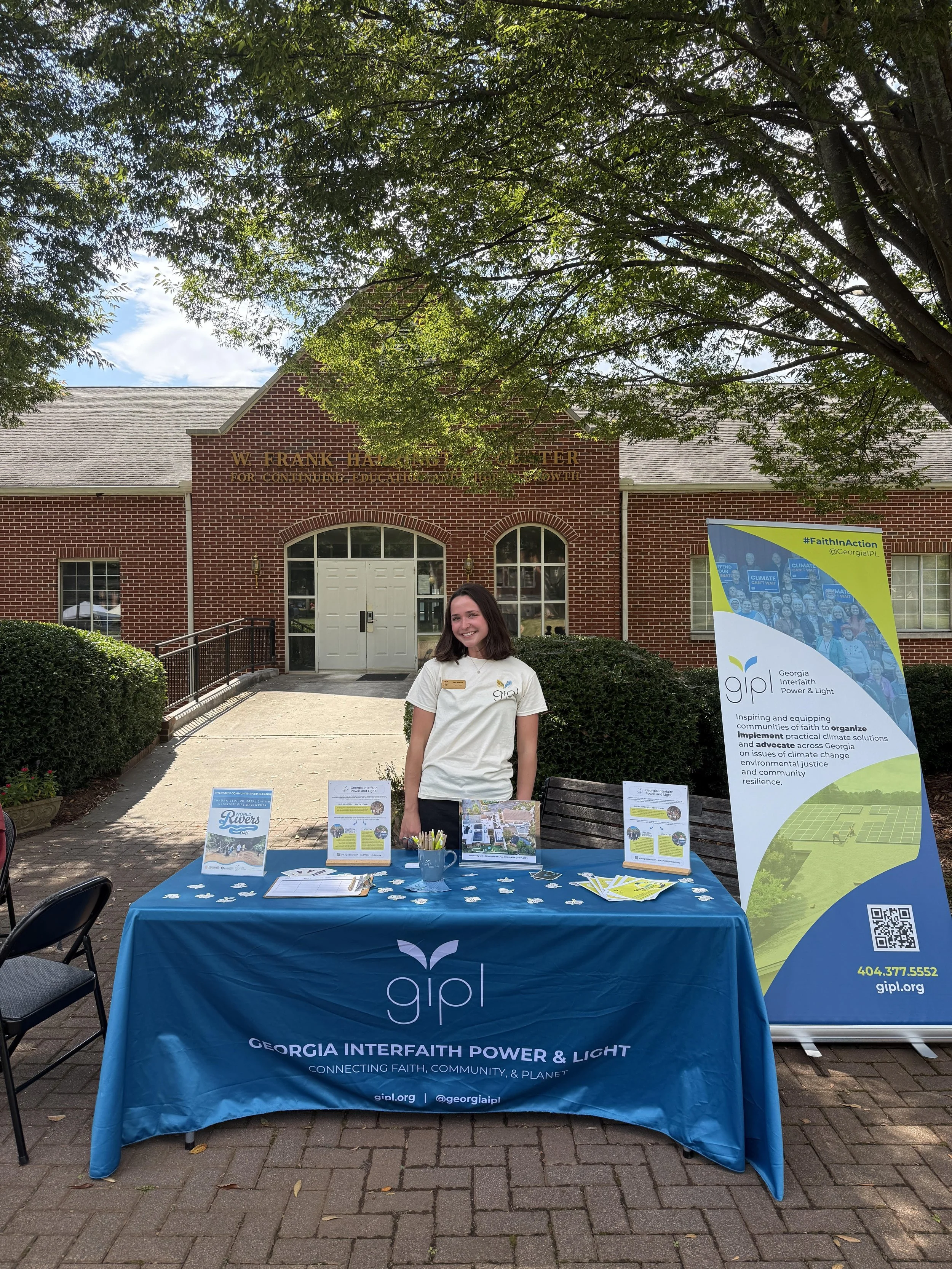
Written by Cate Tedford, 2025-2026 Program Fellow. Photo: Interfaith Atlanta event at Columbia Theological Seminary
For me, reading poetry is like seeing the world again for the first time, especially when it comes to ecopoetry.
The Georgia Review shares, “Ecopoetry generally refers to poetry about ecology, ecosystems, environmental injustice, animals, agriculture, climate change, water, and even food.” Further, the Poetry Foundation writes, “Ecopoetics places emphasis on drawing connections between human activity—specifically the writing of poems—and the environment that produces it.”
Instead of merely writing about nature as if it were a distant, untouchable object, ecopoetry immerses the human imagination in the world of the natural environment, drawing on our human connection, for better or for worse, to our shared, Sacred Earth.
When asked to lead the October Green Team Roundtable, ecopoetry immediately came to mind.
I rediscovered the writing of Mary Oliver at a time in my life when I desperately needed it. Her writing invites humans into belonging with the natural world around us, reminding us that our home is and has always been with the hummingbirds and the egrets, with the mountains and the oceans, the rivers and the deep trees. Oliver’s writing inspired me to cultivate a deeper relationship with the natural world. In her poem “Invitation,” she earnestly inquires if we have “time to linger for just a little while… for the goldfinches that have gathered in a field of thistles.” She reminds her readers that “it is a serious thing just to be alive on this fresh morning in the broken world.”
This practice of paying attention, of holy noticing, of slowing down to witness the “ridiculous performance” of a bird or the interconnected web of living beings, is, as Janisse Ray suggests, our primary job while we are here (see Ray’s poem “Noticing”).
Despite my excitement, I was overcome by a spell of nervousness before October’s Roundtable. For some, poetry can seem frivolous and fussy, and I worried if a group of climate-minded folks would find it useful and worthwhile to discuss poetry amidst the urgent climate crisis we face. Then I reminded myself of my own story and that poetry, particularly ecopoetry, is not a distraction from the work; it could very well be part of the spiritual grounding that sustains it.
The Green Team Roundtable blew me away! For the last part of my presentation, I charged the group with writing their ecopoems, and for the conclusion of the meeting, each participant shared what they wrote. If you would have told me that I was working with a group of lifelong poets, I would have believed you! I was and am so compelled by the words of each person.
Jim shared,
I noticed a Water Oak Tree in my backyard. In measuring its girth and calculating a rough estimate of its age, it has been around since Reconstruction! --A witness to history long before me and will probably outlive me!
Beth wrote,
I notice the nurse log
Giving life while it decays
And the plastic water bottle
That will not break down for thousands of days
Christine expressed,
I notice the choppy water of the Gulf of Alaska. I’m hoping for the perfectly timed shutter click of my camera and the whale’s blow.
But this superficial timing pales by comparison to the warming of your home, OUR home.
David wrote,
The earth is holy, breathed from divine spark,
Each tree a Torah written in bark.
We guard creation, partners in repair,
Bal Tashchit whispers — waste not, take care.
In tending to Eden, we speak our prayer.
I shared,
There it is again
That tender, tangled thread
Of the valleys and the deep trees
The oceans and the rivers
Cupping this sacred dirt between the world and me
Piercing the human heart
Coaxing us back always
This is our work
This is our home.
In February of this year, I had the joy of expanding this practice at the GIPL Green Team Summit, collaborating with Kyarah Barton from Midnight Riot, pairing ecopoetry with collaging.
During our presentation, Kyarah shared how collaging can help us visualize our connection to our Common Home and even facilitate conversations about environmental injustice. By mixing words with visual imagery, such as clippings from recycled magazines, participants were able to express their ideas through multiple media, creating impactful pieces that demonstrate their nuanced relationships with Sacred Earth. This creative thinking outside the box is exactly what the climate crisis demands of us.
In a piece in The Christian Century from 2017, Professor of Religion at West Virginia Wesleyan College Debra Dean Murphy writes:
“The reasons for the deep draw to poetry are no doubt many, but perhaps in this cultural moment we are discovering a particularly salient one: the failure of arguments. Propositional speech and expository writing have always been limited in their power to move and convince, which is why the best orators and authors throughout history have won over their audiences with poetic speech—language rife with image, metaphor, ambiguity, and lyricism and uninterested in didacticism and moralizing. For Christians who recognize the dreariness of staking one’s life solely on a list of propositions to be assented to, poetry turns out to be “like fires for the cold, ropes let down to the lost, something as necessary as bread in the pockets of the hungry.”
In our world that so often demands our efficiency and productivity, reading and writing ecopoetry is an invitation for us to slow down, be, and pay attention; and in slowing down, we get to reimagine our connection to and relationship with our Common Home. I believe this practice is well worth the effort because care is a byproduct of connection. It is much harder to steward and protect what we do not love, and poetry facilitates that love by sharpening our attention. When we notice the “nurse log” or the “choppy water” or the “Torah written in bark,” we resist exploitation and instead see the Earth in its inherent Sacredness and our responsibility to nurture and protect it.
Ultimately, I believe that ecopoetry helps us rediscover our belonging. As we linger with the goldfinches and the forests and all the wonders of creation, we feel more connected to Sacred Earth, to the Divine, and to one another. By infusing our Green Team practices with ecopoetry, we cultivate the imagination and creativity needed to move forward, engaging the climate crisis.