Moral Imagination and Stories of the Future
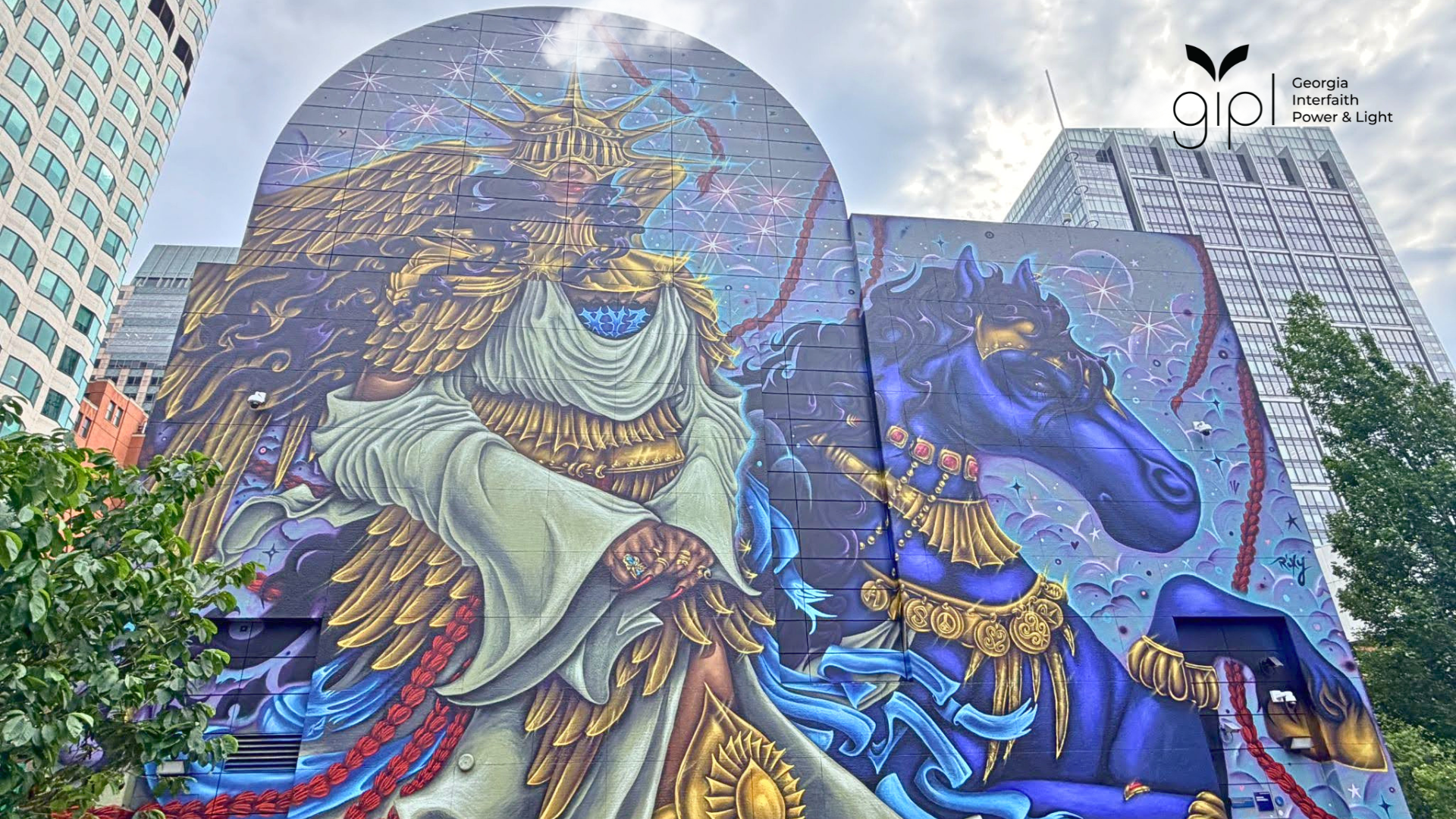
Devotion written and delivered by Beth Remmes on Sunday, July 12, 2026, at the Unitarian Universalist Church of Savannah in Savannah, Georgia. Photo by Beth Remmes.
There are many imagined versions of our world.
Walk into any bookstore or scroll through streaming platforms and you will find entire sections of speculative fiction dedicated to dystopian stories - an imagined world where the remaining people are on a scorched or flooded earth, fighting for survival.
What if a vision of a regenerative, just, and peaceful world permeated our culture as much as, or more than stories like The Handmaid’s Tale or The Hunger Games?
If Einstein is correct, and our imagination is more important than knowledge, and is a preview of life’s coming attractions, then let’s use our moral imagination to tell a new story - where separation, scarcity, and power-over is replaced with connection, abundance, and power-with.
Moral imagination is our capacity to imagine for the well-being of the whole.
It allows us to imagine beyond how things could be, to how things should be, and to look through the eyes of others and stretch the circle of moral concern.
While speculative fiction and the vision for what is possible in a future world is dominated by dystopian narratives, there are other subgenres that widen our sense of what is possible.
There is Solarpunk, which is a literary, artistic, and social movement that envisions and works toward actualizing a sustainable future interconnected with nature and community.
I just learned about the term Hopepunk, which explores resistance, rebellion, and resilience as counters to apathy and cynicism. Characters in this genre fight for positive change, practice radical kindness, and enact communal responses to challenges. I think many of Rivera Sun’s books, like the one I read from today, would fall into this category.
Given that there are very few Utopian novels in existence, maybe there is a sense that humans are too jaded or cynical to write or read about a perfect world. It’s actually hard to even say the word “Utopia” without a note of sarcasm and an eye roll, isn’t it? It seems so impossible. Instead, author and host of the Accidental Gods podcast, Manda Scott, promotes the idea of Thrutopian narratives.
Thrutopian visions craft grounded, plausible, and inspiring route maps from a recognizable present towards a future we’d be proud to leave behind. It arises because dystopian fiction does not offer us any rational way out of the apocalypse. She asks us to consider:
“What happens if we commit to a world based on generative values: compassion, courage, integrity? What happens if we let go of the race for meaningless money and commit instead to the things that matter: clean air, clean water, clean soil…What would the world feel like if I was genuinely connected to all parts of myself, to the people around me, my communities of place and of purpose and of passion, and fully connected as a self-conscious node in the web of life?”
I was thinking about vision and how we could create inspiring route maps when I was in Boston last week, and in between trains I walked out of South Station onto the greenway for a few minutes and saw a beautiful, vibrant mural called The Midnight Ride.
The description says, “Drawing upon practices of creative worldbuilding…the artist, Rixy, asks viewers to consider what their own "Midnight Ride" might be in our current moment: What is the work you engage in outside the hours of 9 a.m. -5 p.m. that helps create the world we want to live in?
I had not heard of the term Creative Worldbuilding, but it grabbed my attention. I looked up the definition, and it is the process of designing a fictional setting or universe for a story, game, or project. Components of creative worldbuilding typically include History & Lore, Setting & Geography, Culture & Society, and Rules & Systems. So, using my moral imagination and evidence-based dreams that I have held onto for years, here’s my attempt at creative worldbuilding with a thrutopian vision to create a new story.
In the year 2026, most people seemed to operate in the Business as Usual story, where the goal is to maximize profits, at the expense of people and the planet. “Faster,” “Busy,” and “More” are common mantras in this linear, power-over, extraction-based system built on the fallacy of unlimited growth.
Many scientists, scholars, and others woke from the delusions of consumer-driven society often put much of their energy into detailing how Business as Usual is causing the Great Unraveling, from the catastrophic consequences of climate change to the economic and political instability that followed. But this caused many people to shut down and feel paralyzed.
During this time, there were other groups of people who were tired of giving their life force energy to documenting and resisting the unraveling. They created islands of coherence in the seas of chaos. They took many different forms and had many different names, like green teams, eco-spiritual futurists, solutionaries, deep adaptation networks and transition towns. They were like points of acupuncture mapped out along a meridian throughout that world, stimulating personal and planetary healing.
In 2040, one of these islands of coherence became a thriving community- let’s take a look at what it would be like to live there.
Imagine waking up to natural light and bird songs flooding through the windows in your bedroom. Your home is modest, but it lovingly holds all the essentials and meaningful treasures that you have accumulated over the years. While you slept, the energy that your house collected from solar panels during the day kept the water warm for your shower, ran the appliances, and had surplus energy to store and give back to the main grid to help power the public utilities. Because your house is so energy efficient, it maintained a comfortable temperature while you slept.
The water from your shower goes into a grey-water system in your house, which supplies the toilets and is also used to water your garden, along with your rain barrels. You step outside and water your lovely garden with this reclaimed water and pick some ripe fruits for your breakfast, along with a few fresh eggs from your speckled heirloom chickens. Rather than a lawn, your land plot is filled with fruits, vegetables, native plants, and habitats for the butterflies and honeybees.
A block up from your house is one of the many community gathering areas, with playing fields, open-air markets, storefronts showcasing local goods, meandering woodland paths with fruit trees, and a beautiful stage which showcases anything and everything – from bluegrass to classical music, to dancing, storytelling, and art displays.
As you walk through the commons, you pass by the co-housing units where the dwelling areas are private, but the extensive common facilities are shared by the multi-generational residents. It is not uncommon to see teenagers helping out their elderly neighbors after school, or families making dinner together while their children play safely together in the yard.
Just a bit further down the permeable roadway is the community center, which is covered by a vertical garden, and houses a local bank, tool library, book exchange, repair-or-reinvent shop, farm-to-table restaurant, rental center for cars and bicycles, and an internet café where you can log into the community time bank and swap your carpentry skills for a friend’s accounting skills.
In this town, there is a business-center hub, where people from various professions share office space, so that they are not isolated and have the benefits of office amenities, yet do not have to endure a long commute. The building is a zero-waste facility with a green roof, a courtyard, and small wind turbines and solar panels on the roof to generate electricity. Everything is reused, recycled, or composted. This hub is a center for learning, connecting, and sharing ideas using an open source methodology that promotes free redistribution and access to product design and implementation. This office center is also home to one of the leading Biomimicry firms, which uses nature’s time-tested patterns and strategies to design a myriad of solutions, from more efficient wind turbines inspired by humpback whale fins to biodegradable textile fibers inspired by spider webs. AI is used in weather forecasting, climate modeling, environmental monitoring, and other data-heavy fields, but it is not a replacement for creativity and connection.
At night, this community center offers a variety of lectures, films, debates, and music, which appeal to the diverse population in the area. At events like these, people celebrate their customs and traditions, but also realize that we are much more similar than we are different.
For the people in this town who need to commute into the city center or another surrounding area, they can easily access the closest train station, where a clean, renewable energy train runs every ten minutes into town. Or they can use the extensive bike and walking trails, which are the main arteries linking neighborhoods together along the public transit system.
Many corporations have given way to member-owned cooperatives, business externalities are now part of the cost of doing business, and people and planet are just as important – if not more so- than profit.
While the laws of the community are fair, unbiased, and communicated clearly, there are unfortunately times when a law is broken. This community justice system is modeled after the Māori, the indigenous people of New Zealand, where the community is involved in the process, and the intended outcome is repair. It is a restorative justice program which is designed to address the victims’ needs and support offenders as they take responsibility and change their behavior, and to empower the offenders’ families to play an important role in this process.
In this community, there is less of an emphasis on party politics, yet there is a thriving democracy, with engagement in local government and policies. The focus is primarily on creating a resilient infrastructure. Since the community produces the majority of its power, has reliable access to healthy organic food from its gardens and nearby producers, has a clean water source that maintains safe levels due to water conservation programs, and has mutually beneficial relationships with nearby communities, there is the sense that it would be able to recover from disruptions caused by climate change or global events.
Because of the abundance of fresh fruit and vegetables from a nearby regenerative farm, ample opportunities for outdoor recreation, and low stress levels, due in part to a culture of community rather than consumption, people are generally healthier. But when a doctor’s care is necessary, there is a publicly funded state-of-the-art medical center close by, with a holistic approach to health care, including acupuncture, energy medicine, and a medicinal herb garden on the grounds.
Near the healthcare facility lies an interdenominational worship center. Various groups in the community use this space, and others nearby, to come together to mark major life events and celebrate their faith traditions. People respect each other’s beliefs and appreciate the freedom to explore their connection to the divine in the form that is most meaningful for them.
The last stop in our tour around town is the beautiful school campus made up of Living Buildings that consist of seven performance categories, or “Petals”: Place, Water, Energy, Health + Happiness, Materials, Equity, and Beauty. There are outdoor classrooms and permaculture gardens which supply the culinary arts program and cafeteria. In addition to the core courses and valuable life skills, students are taught non-violent communication, systems thinking, mindfulness and meditation, and how to be a responsible global citizen who advocates for human, animal, and environmental rights.
This school encourages lifelong learning by offering continuing education classes at night on a wide array of topics. As we watch the children climbing on the inclusive playground that is made from reclaimed and recycled materials, we see the light in their eyes that comes from being born into a community where they will never face discrimination based on their gender, race, or sexual orientation. They also know that they are free to pursue their gifts and cultivate their talents, without sacrificing prosperity, because they live in a place where they are valued and fulfilled by the simple pleasures in life.
There is peace in your heart, because you can see this way of life continuing for the next seven generations.
What story about the future does your moral imagination want to tell? What memories of the future are we envisioning that create longing and a deep felt sense of what we're building toward, not just running from?
I encourage you to join with others - like at GIPL’s Green Team Summit on Aug. 15 - to expand upon this vision of a peaceful, regenerative community and become co-creators in our conscious evolution.