A Sermon about the Season of Creation
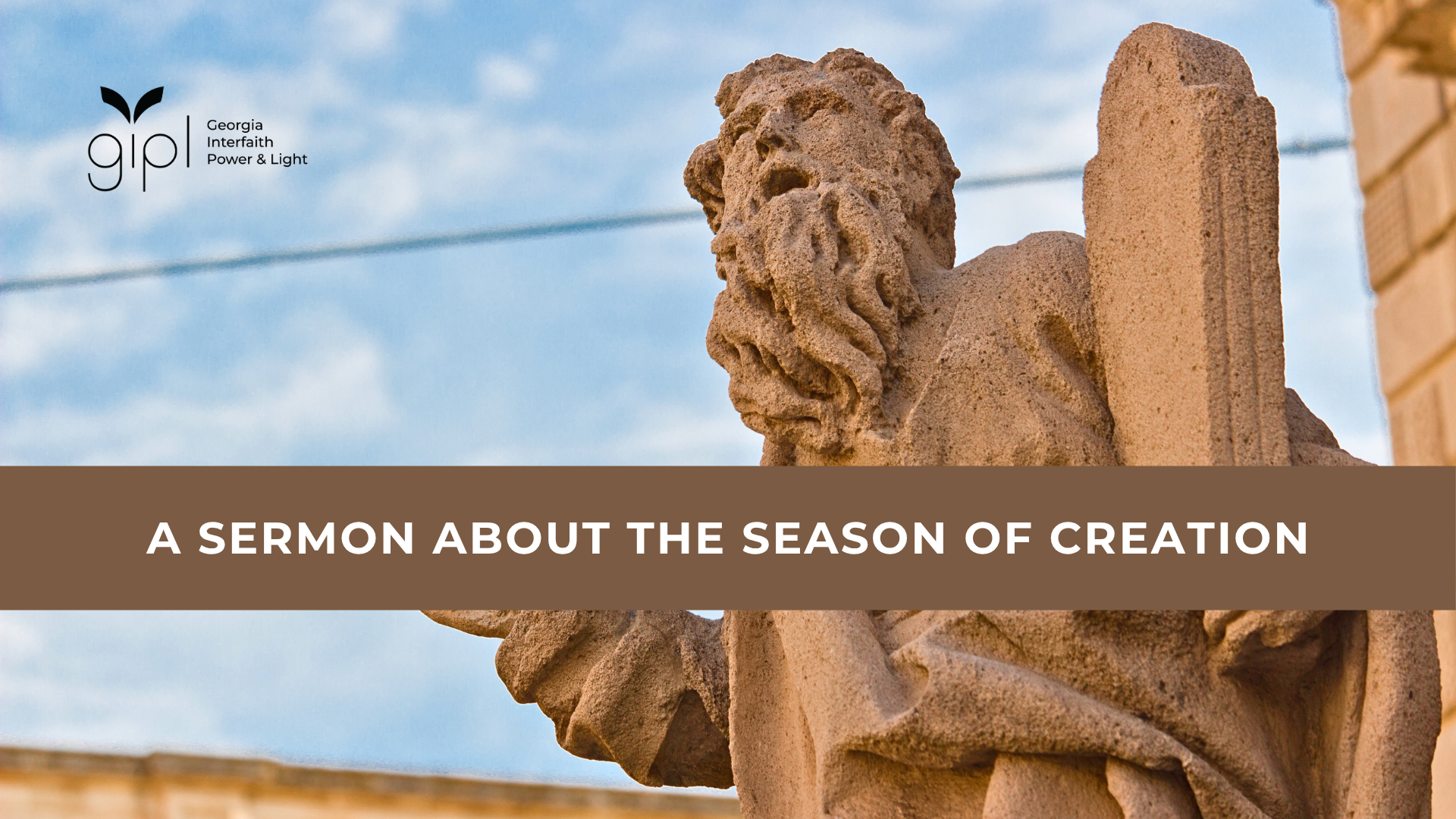
Written and delivered by Codi Norred at the Episcopal Church of the Epiphany in Atlanta, Georgia, on September 13, 2026.
The Season of Creation liturgy is a time in which we seek to renew our relationship with the Creator and all Creation through celebration of what is around us, and our calling to safeguard this sacred earth and its inhabitants.
In preparing, I was struck by the dissonance between the traditional liturgical texts for this morning, specifically the Exodus passage, when compared to the text offered by The Season of Creation Liturgy.
The Exodus text this morning is likely a familiar one. Moses’ parting of the Sea. The Season of Creation text comes from Ezekiel 47:9 and 12. Since we didn’t have that read aloud this morning, I want to read it for you now.
The text of Ezekiel says “Swarms of living creatures will live wherever the river flows. There will be large numbers of fish, because this water flows there and makes the salt water fresh; so where the river flows everything will live.”
And, “Fruit trees of all kinds will grow on both banks of the river. Their leaves will not wither, nor will their fruit fail. Every month they will bear fruit, because the water from the sanctuary flows to them. Their fruit will serve for food and their leaves for healing.”
Doesn’t that sound nice? This promise in Ezekiel is later lifted up by the prophets in Revelation as a promise of what will be after the end of days, living water flowing from the throne of God. And the leaves of the trees will heal the nations. An incredible offering of how the natural world is bound up in our mutual flourishing and the peace of the world.
But if I am honest, it seems like we are very far from the promise of Ezekiel and the Season of Creation.
I feel like I am much closer to Moses on the side of the Red Sea than I am a flourishing world. I feel between two places. Between a peril and a promise.
In a desperate fight to care for our environment, our Sacred earth, and each other - I am at a loss. Our national parks are being sold off for data centers and oil fracking. Companies abandon their climate commitments as fast as the trees will soon shed their leaves for fall. So too, Georgia Power abandons its commitments to close coal fired power plants, instead deciding to double its generating capacity with gas combustion plants and methane pipelines, again to fuel data centers and heavy industry. Bills rising all the while. Rivers begin to run dry across our state. We continue to plead with every elected official we can to permanently protect the great Okefenokee Swamp from titanium mining.
Do you feel the rumble of Pharaoh’s chariots yet? Do you see the dust kicking up in the horizon? Do you hear the yelling?
People are forced to choose between paying their astronomical power bills or buying medicine. In the 5 year span between 2018 and 2023, the City of Atlanta lost over 780 acres of tree canopy. About half an acre a day.
Do you feel the rumble yet? Our backs are against the water. Can you feel how scared your neighbors are?
Fires raged this year in South Georgia to an extreme I have never seen. Federal funding cut, EPA gutted, water regulations thrown out the window. PFAS, forever chemicals, polluting streams from North Georgia to the Coast.
Sometimes it’s like Pharaoh's army of destruction is almost here. Disaster is on the doorstep. I can taste the sand in my mouth. And as destruction grows closer, my ankles are in the sea.
What are we going to do? How do we get from where we are - from the banks of the proverbial Red Sea, with the seeming promise of destruction ever closer, to God’s promise of Ezekiel? To the celebration of the so-called Season of Creation? We are nowhere near clean water flowing from the throne of God, nor are we anywhere near fruit trees for all, or leaves that can heal anything.
How do we get from here to there?
I don’t even know if this Sea will part. When will it part? When will we be delivered or at least shown a way out?
In the Exodus text, as it is often told, Pharaoh's armies are chasing Moses and the freed slaves from Egypt. And as they draw near, God commands Moses to lift up his staff, and we know the story well - the Sea parts and they narrowly escape. Ta-da. Moses asks for help as danger approaches and passage is given.
But it isn’t that simple. Relief doesn’t come as easily as we oft remember.
In Jewish midrash, the large body of teachings and commentary held and contributed by rabbinic scholars for generations, adds something critical to this text. And it gets at the real position that I think we are in - and at least what I am feeling.
In the midrash, Moses doesn’t simply lift his staff resulting in the parting of the sea. Actually in the text, God says to Moses: “Why do you cry to me? Tell the children of Israel to go forward.” Go where there is no path.
Rabbinic sages offer the story of Nachson, a member of the tribe of Judah present with Moses at the edge of the water. Here is what they say:
When Israel stood racing the Sea of Reeds and the command was given to move forward, they hesitated saying “Are we to jump into the sea?”
Nachshon saw what was happening - and jumped into the sea. He waded deeper and deeper into the waters.
At the very last moment, as the waters reached up to his nostrils and threatened to drown him - only then did the Red Sea part.
How do we get from being pushed into the sea to the river flowing from the throne of God?
How do we get from a world where the smoke rises, the world heats, species die, our elected officials abandon us, and our neighbors cannot pay their bills and do not have clean water?
How do we get from today to the season of Creation and abundance?
I think we take a hint from midrash. We get into the water up to our eyes. We go so deep in our work, in our calling to safeguard Creation and each other that we almost suffocate. We do not let up. Though we cannot see how the promise of Ezekiel will ever come to be, though we may feel caught between approaching destruction on many fronts and a sea to our back - we must believe the promise so deeply, the vision so relentlessly, that we do not cease in our calling even when it seems hopeless.
To hope in the face of hopelessness is the very fabric of our faith. Dive into the Sea not knowing if it will part.
Today the way toward a flourishing and just world is clouded by dust from chariots, by the actions of unfit rulers threatening to run us into the ground. And yet, that is not an excuse to let up on our work, it is an affirmation that our work to tend the garden is evermore important - for if we do not try - who will try?
If the people charged with this calling do not believe it - how will the Holy be able to show up in our midst? If we do not seek the promise of Ezekiel even when we are being forced into the Sea - how will it ever become?
The Season of Creation is here - whether we feel it everyday or not. And the work is ours - whether or not we can see a clear path to create the world we so desperately long for. Are we not the faithful? Surely we do not waste our time in worship to be unfaithful. Have we not been charged to keep the Garden? To feed the hungry? To seek peace when war surrounds the world. To do the work when it is terribly hard.
In Islam, it is taught that even if the Day of Judgement is starting and you hold a small plant, you should finish planting it. For we are not in charge of the future, but rather our right and good action today.
I think that rings true. We do not know how we will get from here to the promise of Ezekiel, but I know that we won’t get there if we do not think it is possible. Rather, we must make the promise real in our every effort. We must not just believe it with our heads and our hearts, but with our hands and our feet in the place that we find ourselves. We have to make it real right here. With everything we have.
It is hard to hope in these times - so to close I want to offer a poem from one of our saints who kept this path his entire life and recently left us.
Hear now the words from Wendell Berry’s Sabbath Poem: “It is hard to have hope”:
It is hard to have hope. It is harder as you grow old,
for hope must not depend on feeling good
and there’s the dream of loneliness at absolute midnight.
You also have withdrawn belief in the present reality
of the future, which surely will surprise us,
and hope is harder when it cannot come by prediction
anymore than by wishing. But stop dithering.
The young ask the old to hope. What will you tell them?
Tell them at least what you say to yourself.
Because we have not made our lives to fit
our places, the forests are ruined, the fields, eroded,
the streams polluted, the mountains, overturned. Hope
then to belong to your place by your own knowledge
of what it is that no other place is, and by
your caring for it, as you care for no other place, this
knowledge cannot be taken from you by power or by wealth.
It will stop your ears to the powerful when they ask
for your faith, and to the wealthy when they ask for your land
and your work. Be still and listen to the voices that belong
to the stream banks and the trees and the open fields.
Find your hope, then, on the ground under your feet.
Your hope of Heaven, let it rest on the ground underfoot.
The world is no better than its places. Its places at last
are no better than their people while their people
continue in them. When the people make
dark the light within them, the world darkens.
So we must keep the light, the hope. We must be the bridge between the chariots that rumble across the ground and up to us now, and the world that is to come - the promise in Ezekiel, then lifted up in Revelation, and proclaimed now as the theme to the season of creation. We have today to push as far as we can. If we are lucky, we get to do it again tomorrow.
How do we bridge these times? We wade into the water - up to our nostrils, up to our eyes. We do the work gasping for air if that’s what it takes.
May we wade into the water faithfully knowing the seas will be parted when it is time, knowing that the world of abundance does not come about in our worrying, but in our faithfulness to love a place up to our eyelids. Hope is the bridge. Oh how difficult to hope. How difficult to remain faithful until almost drowning, and yet, when there is no hope, and there is no clear path, we still must do our work. We are still called to love a place, this place, and each other - to help the Sacred Earth flourish. Onward to this great task.