Summer of Advocacy 2026: The True Cost of Fossil Fuels
Written by Marqus Cole, GIPL Organizing Director, and Ayesha Abid, GIPL Policy & Advocacy Coordinator.
Power Trip: Taking Advocacy Across Georgia
Before we hit the road, the Georgia Interfaith Power & Light (GIPL) Organizing Team knew our Summer of Advocacy: Power Trip would be a journey. A journey that connected faith, environmental justice, community, and advocacy while helping Georgians better understand where our power comes from, what it truly costs, and the power communities have to shape what comes next.
Our outlook for the summer was simple: go be where the people are.
Into churches and faith communities.
Into neighborhoods and community spaces.
Along Georgia's rivers. Into advocacy spaces.
Our Power Trip took us into churches and faith communities, on college campuses, into advocacy spaces, and even to Washington D.C.
Virtual Kickoff
We launched the Summer of Advocacy with a virtual kickoff designed to ground our work in education, relationship building, and collective action.
The kickoff also established that advocacy does not begin when we enter a legislative office or sit across from a decision-maker. Advocacy begins in our communities.
It begins when people have access to information, understand how environmental and energy decisions affect their daily lives, recognize their own power, and have opportunities to act. With that foundation established, our Organizing Team was ready to take the Summer of Advocacy on the road.
Columbus Power Trip Stop
Our first stop was St. Thomas Episcopal Church in Columbus, Georgia.
We discussed a proposed pipeline expansion, how to advocate around a proposed data center siting, and ways to get involved in clean energy advocacy efforts in Columbus.
Participants also got to hear from GIPL staff about how planting and protecting trees — especially in underserved neighborhoods — can advance justice and build climate resilience.
Albany Power Trip Stop
From Columbus, we traveled south to Albany State University.
Hosting an Environmental Justice 101 workshop on Juneteenth at a historically Black college or university (HBCU) gave the stop special significance, connecting environmental justice to leadership, service, and the responsibility each generation has to the communities it inherits.
We challenged students to recognize that identifying injustice is only the beginning. Creating change requires informed people who are willing to use their voices, organize, advocate, and act.
D.C. Fly-In: Taking Community Voices to Capitol Hill
The journey took the GIPL team from communities across the state to Washington, D.C. for our federal advocacy fly-in, where we carried the issues, stories, and concerns we heard on the ground directly into conversations with federal decision-makers.
Our team engaged congressional offices and elevated issues impacting communities across Georgia, including energy affordability and energy burden, fossil fuel and pipeline infrastructure, environmental justice, the rapid growth of data centers, and the importance of ensuring rural and historically underserved communities are represented in major energy and infrastructure decisions.
Our goal was not simply to have a seat at the table, but to make sure the voices, experiences, and concerns of Georgia communities were represented at that table.
Augusta Power Trip Stop
In mid-July, we stopped at the Islamic Society of Augusta. Following midday prayer, advocates from the Augusta and Central Savannah River area explored the connection between data centers, energy burden, and a proposed methane pipeline expansion that would run through Augusta. The conversation asked participants to contemplate who bears the cost when Georgia makes these decisions to power its future.
The True Cost of AI
Our Power Trip also had a stop at the first “living building in the Southeast," the Kendeda Building, located on Georgia Tech’s campus. The event, The True Cost of AI, emerged out of a partnership with Candler School of Theology and Pitts Theology Library and explored the basics of artificial intelligence, how these technologies work, and the ethical questions they raise, especially when it comes to data centers, fossil fuel infrastructure, and care for the environment.
Savannah Power Trip Stop
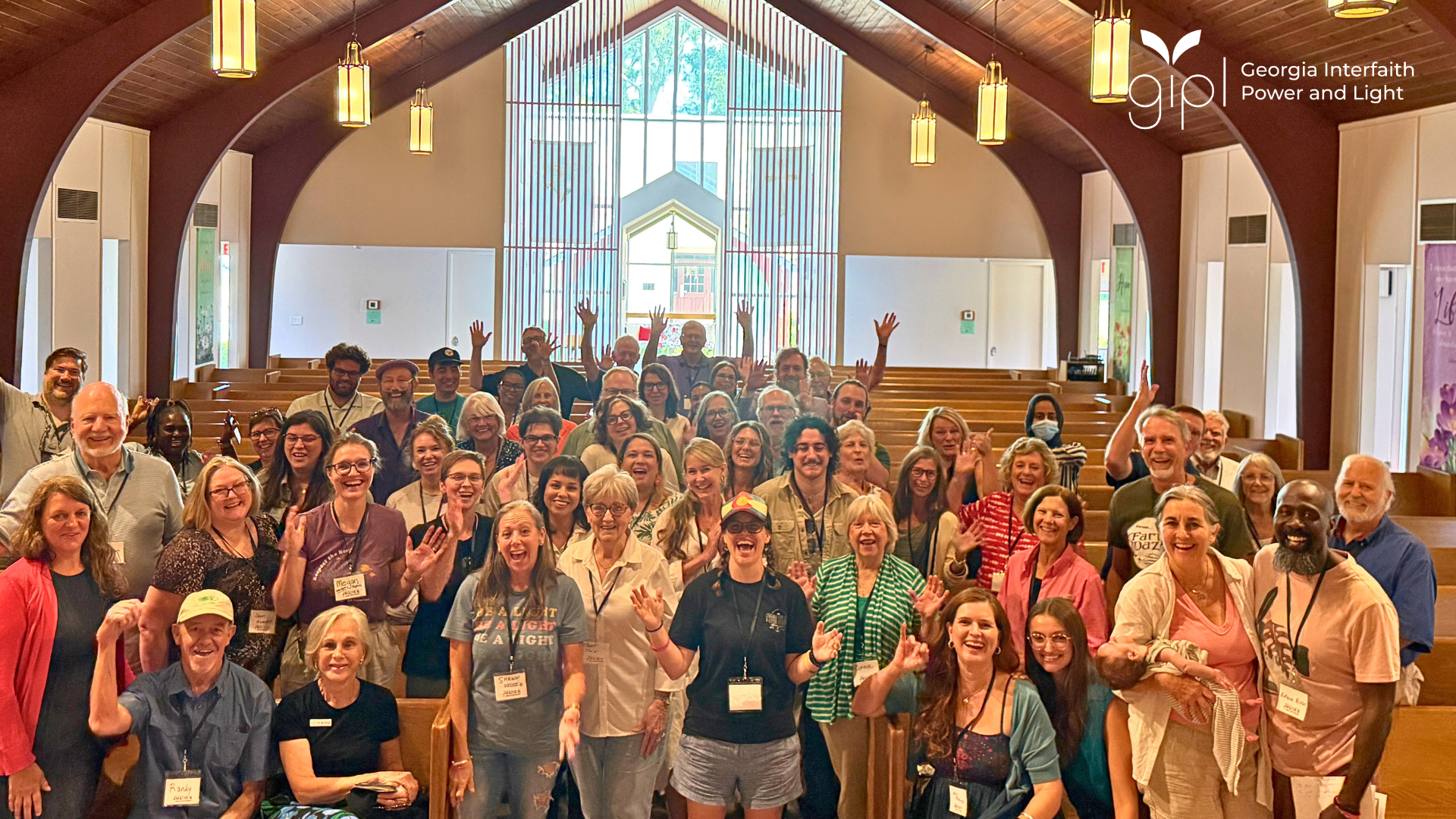
Our Power Trip came to a close during our Coastal Green Team Summit at White Bluff Presbyterian Church.
The coast can feel far removed from the hustle and bustle of Atlanta, but it is extremely vulnerable to the impacts of climate change. Too often, when our policymakers make decisions in Atlanta or D.C., Savannah residents miss out on the opportunity for their voices to be heard.
Savannah activists gathered to discuss Project Camellia, the $20 billion data center, and other community issues during our last Power Trip stop and made plans to continue gathering, working together, and making sure that the quality of life for coastal residents is considered in these decisions.
The Road Ahead: PSC and GOTV Calls to Advocacy
GIPL has been following the pathway of power across Georgia, helping folks understand how energy is produced, who pays for it, who benefits from the underlying systems, and what our faith calls us to do when the burden of these systems is not shared equitably.
Energy policy is not just about transmission lines, pipelines, power plants, or our utility bills — it is about people and the places we love. It is about the air we breathe, the land we steward, the homes we cool down in the hot Georgia summers, and the kind of communities we want to leave behind for those who come after us.
Our Power Trip was about power in another sense too, the power we have when we organize together. The work of responding to the call to protect the planet and make the world a better place to live for all living creatures is a 365 commitment.
The Georgia Public Service Commission (PSC) is currently considering a Data Center Docket (Docket No. 5171, the Real-Time Pricing, or RTP, Docket) which investigates who is, and is not, paying a fair cost for fuel.
You do not have to be an energy expert to participate. You can share the experiences of people in your congregation and community. You can use this opportunity to turn your voice into your power.
You can also have your Green Team or organization participate in GIPL’s Get Out The Vote (GOTV) grant program. GIPL is non-partisan and does not advocate for any person or party, but we understand that many Georgians do not have a good understanding of the PSC and may not be paying attention to the race. Go to gipl.org/vote to learn more about this opportunity.
Our journey to build power continues!